The Courtyard With a Conscience: Six Almshouses Where a Bequest Still Has an Address
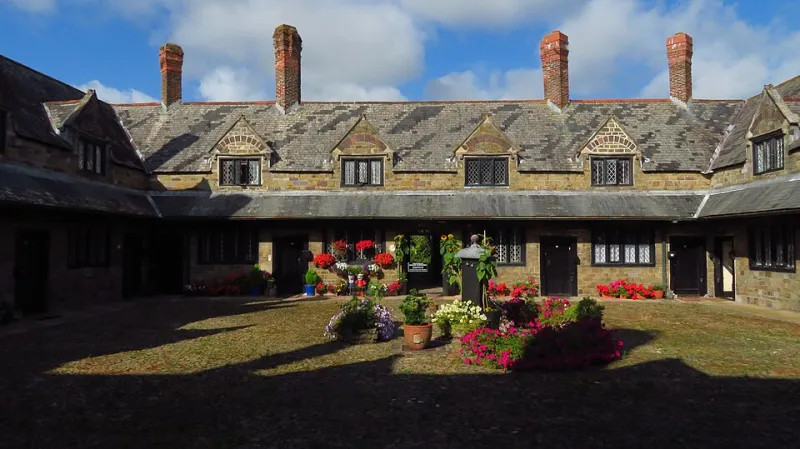
Photo: Colin Park , CC BY-SA 2.0, via Wikimedia Commons
Almshouses are easy to miss. They sit behind low walls, at the end of a passage, or along a street you have walked a hundred times without looking up. Yet they are some of the most revealing buildings for family historians, because they were rarely built by committees. They were often built by a person, or a family, who wanted their name attached to a promise. The six below still carry that promise in stone, in paint and in paperwork.
A word first: these are homes, not visitor attractions. Some welcome visitors to a chapel or courtyard; others ask you to admire from the gate. Check opening arrangements before you travel, keep your voice low, and treat the residents' privacy as part of the heritage.
Read the board before the brick
Before you start photographing doorways, find the charity board. It is usually in a hall, a chapel porch or a notice case, and it will tell you who founded the place, when, and for whom. Look for the founder's surname, the date of the endowment, and any later names added by marriage or inheritance. Then look at the foundation stone. The wording on these stones is often more useful than a guidebook, because it records the exact relationship between a family and a building: founded by, endowed by, rebuilt by, enlarged by.
After that, read the courtyard. Almshouses tend to follow a pattern: a gate, a quadrangle, a chapel, a communal hall, and a row of dwellings. The plan tells you how residents were expected to live. The chapel tells you what was expected of them. The board tells you who paid.
1. Whitgift Almshouses, Croydon
John Whitgift, Archbishop of Canterbury, founded these almshouses in 1596, and the Whitgift name is still part of the local furniture. The courtyard off North End has the feel of a small college, with a chapel and a sense of enclosure that makes the traffic outside seem further away than it is. Look for the founder's arms, the later inscriptions, and the way the buildings have been repaired rather than replaced. For records, start with Croydon Archives and the Whitgift Foundation. Admission books, pension lists and charity accounts can show a resident's name, age, former occupation and parish.
2. Abbot's Hospital, Guildford
George Abbot, another Archbishop of Canterbury, founded this hospital in 1619. The word hospital here means hospitality, not medicine: it was a place of shelter and support. The High Street entrance gives little away, but the courtyard behind it is a fine place to slow down. Look for the chapel, the founder's portrait or arms, and the board listing the original rules. Surrey History Centre is the place to begin if you want to trace a resident. Almshouse records often include petitions, which are gold dust: they may state why someone needed a place, who recommended them, and what they were given.
3. Sackville College, East Grinstead
Do not be misled by the word college. Sackville College was founded in 1609 by Robert Sackville, Earl of Dorset, as an almshouse, and it still has the rhythm of a charitable foundation rather than a school. The chapel and hall are the parts to linger over. The Sackville name appears in the foundation story, but the real family history is in the admissions: who came in, who stayed, who left. Local record offices and the charity's own archive are the first ports of call. If your ancestor lived here, search the census for the institution's address as well as the person's name.
4. Morden College, Blackheath
Sir John Morden founded this college in 1695, and the name still sits over the gate. The buildings have that late seventeenth-century confidence: brick, symmetry, a chapel, and a courtyard that feels deliberately set apart from the road. Morden College is a good example of an almshouse that was also a statement of civic virtue. Look for the founder's name and arms, the charity board, and any later benefactions. The college's archive and local history collections are the obvious starting points. If you are tracing a resident, ask about admission registers, allowances and chapel attendance.
5. Leicester's Hospital, Warwick
Robert Dudley, Earl of Leicester, founded this hospital in 1571, and it is now better known as the Lord Leycester Hospital. It was intended for old soldiers, and the word brethren still carries a whiff of the barracks. The timber-framed buildings are a delight, but the family history is in the foundation: a Dudley promise, a set of rules, a chapel, and a long list of men who came to live out their years under that name. Warwickshire County Record Office is the place to look for records. Do not expect everything to be online; almshouse archives are often stubbornly paper-based.
6. Beauchamp Almshouses, Newland
The Beauchamp Community at Newland, near Malvern, was founded in 1864 by the Earl Beauchamp. It is Victorian Gothic rather than Tudor, which makes a useful contrast: here you can see how the almshouse idea was revived and dressed up in a new century. The chapel is the centrepiece, and the family name is woven into the architecture. For records, try Worcestershire Archive and Archaeology Service. Victorian almshouses often kept more paperwork than earlier foundations, including application forms and references, which can be wonderfully specific about an ancestor's circumstances.
What the records can tell you
Almshouse records vary enormously. Some foundations have complete admission registers; others have almost nothing. The common documents include admission books, petitions or application letters, rules and ordinances, accounts, clothing lists, and chapel attendance. A single entry might give you a name, age, parish, former trade, marital status and the reason for admission. That is a lot for one line in a book.
Start with the local record office, the charity itself, and the Charity Commission's register. The Almshouse Association can also point you towards member foundations. Write ahead, be specific, and do not assume a same-day search. Many collections are held off-site.
The ancestor in the courtyard
What makes almshouses so useful is their scale. A workhouse can swallow a family in a crowd; an almshouse places them in a room. If you find an ancestor there, you are not just tracing a name through a register. You are standing in the courtyard they crossed, looking at the chapel they attended, and reading the board that set out the terms of their shelter. The founder's family name may not be yours. But the institution's name might be the one that kept your family's story in one place.
Go slowly. Read the board. Look up at the stone. Then go and find the register.